Propane Systems
Why Propane Heating?
In rural Maine, the choice for whole-home heating typically comes down to oil or propane — natural gas infrastructure simply does not reach most of Waldo County. Both are legitimate options, and the right choice depends on your existing infrastructure, fuel price trends in your area, and the efficiency of the system being installed.
Modern high-efficiency propane boilers extract significantly more heat from each gallon of fuel than standard equipment — the efficiency advantage is real and compounds over a full heating season. Propane burns cleaner than fuel oil, with less soot accumulation on heat exchanger surfaces. There is no risk of fuel gelling, no tank sludge buildup over years, and no concerns about the water contamination issues that can develop in aging oil tanks.
The primary consideration with propane is on-site storage. Propane must be stored in dedicated tanks — most propane suppliers own the tank under a lease arrangement, which typically means you're tied to that supplier while the tank is on your property. Factor delivery accessibility and supplier reliability into your decision.
Oil vs. Propane: The Real Story
We service both oil and propane systems. We don't have a financial reason to push you one way or the other. Here is an honest breakdown to help you think through the decision.
- New construction or oil-to-propane conversion where you're choosing from scratch — no existing tank or infrastructure to work around
- Existing propane infrastructure already on the property
- When pairing with propane-fired generators — many rural Maine homes run whole-house LP generators, and sharing fuel simplifies logistics
- When a high-efficiency condensing system will be installed — the efficiency advantage over a standard oil system is meaningful over time
- When indoor air quality is a priority — propane burns cleanest of the liquid fossil fuels
- Existing oil system in good mechanical condition — conversion costs real money, and a well-maintained oil burner has years of service life left
- When oil prices in your area are favorable — fuel price volatility makes this a moving target, but it matters
- Established delivery relationships and a reliable local supplier — this is genuinely valuable and often underweighted
- When a new double-wall oil tank installation is already planned — the tank upgrade makes sense as part of an oil system continuation
What a Proper Installation Involves
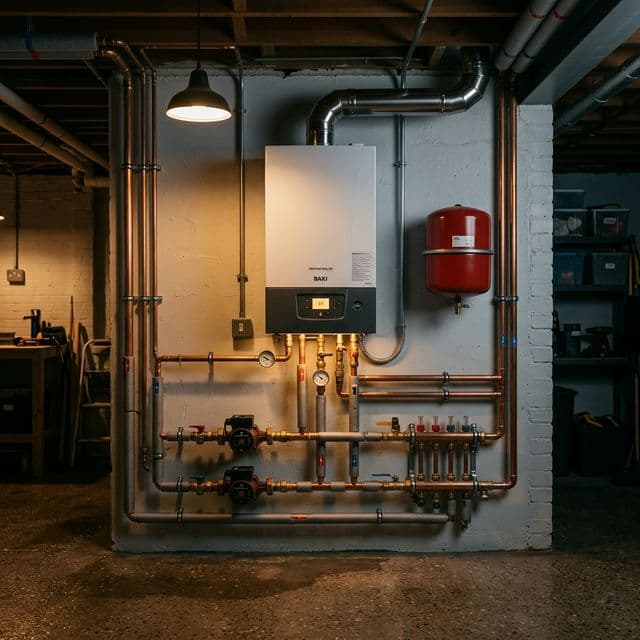
A propane heating system is only as good as its installation. Equipment selected without a load calculation, gas lines sized by eye, and venting run beyond specification all compromise performance, efficiency, and safety. Here is what every installation requires.
Proper Load Calculation
Before any equipment is selected, the home's heating load needs to be calculated — accounting for insulation, windows, ceiling height, and local conditions. Oversizing a boiler is as problematic as undersizing: an oversized system short-cycles, wears out faster, and never reaches its efficiency potential.
Equipment Selection
Modern high-efficiency condensing propane boilers extract significantly more heat from each gallon of fuel than older equipment — the efficiency gap is real and compounds over a heating season. The right system depends on existing infrastructure, efficiency goals, and long-term reliability.
Gas Line Sizing
The supply line from tank to appliance must be properly sized for the total demand of all connected equipment. An undersized line causes pressure drop under peak demand, which forces the appliance to reduce output or fault out. Line sizing must account for all connected appliances and the full run length.
Venting
Condensing propane boilers require different venting than conventional equipment — they cannot use standard metal flue pipe. Venting must meet manufacturer specifications, including proper intake and exhaust routing through the exterior wall or roof.
Condensate Management
Condensing boilers produce water as a byproduct of their efficiency. This condensate must drain to an approved location — proper handling is required by code and is part of every condensing unit installation.
Commissioning
A properly commissioned propane system is a safe, efficient one. Commissioning verifies gas connections, combustion analysis, zone controls, thermostat function, and system operation before hand-off.
Annual Propane Heating Service
Propane furnaces and boilers require the same commitment to annual maintenance as oil equipment — and they have their own specific failure modes. Gas valves can stick or develop slow leaks. Ignition systems fail. Condensing units require condensate drain inspection on top of standard checks. Annual service keeps these issues from becoming emergencies.
Annual service covers the full burner assembly — gas valve, igniter, and flame sensor — along with combustion analysis, gas pressure verification at the appliance, and a gas leak check on all connections. Heat exchanger integrity is inspected for cracks, scale, or corrosion. On condensing units, we inspect the condensate drain as part of the service.
Every visit includes a CO detector function check and a full zone valve, thermostat, and system run cycle verification before we close out. These aren't optional add-ons — they're how we make sure the system is safe and operating correctly for the season ahead.
Gas Appliances and CO Safety
Every propane heating appliance should be protected by a working carbon monoxide detector in the living space. Propane combustion produces CO. A cracked heat exchanger, a malfunctioning burner, or insufficient combustion air can all lead to elevated CO levels — which is colorless, odorless, and dangerous. CO detector function check is part of annual service. If you don't have one, install one before the heating season begins.
Ready to Schedule?
Call us directly or send a message and we'll get back to you.