
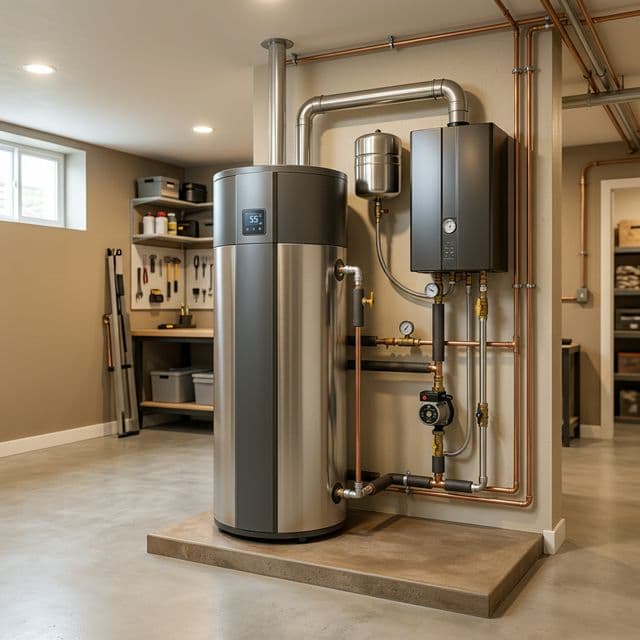
Water Heaters
The Right Water Heater for Your Home
Most people inherit their water heating setup when they buy a house and never think about it until it fails. That's a reasonable approach until the day you have no hot water mid-shower, or you discover a puddle on the basement floor. Understanding what you have — and when it's time for a water heater replacement — is worth a few minutes of thought.
The three main water heater types used in Maine homes are:
Indirect Tank
Uses your existing boiler as the heat source. Most efficient and longest-lived option for any home with a hot water boiler.
Direct-Fired
Standalone oil or propane water heater with its own burner. Required for homes with forced hot air heat or electric heat.
Rinnai Tankless
On-demand propane hot water with no standby losses. Ideal for new construction or full system upgrades.
Indirect Water Heaters
If your home is heated by a hot water boiler — oil or propane — an indirect water heater is almost certainly your best option. This is the solution we recommend most frequently, and for good reason.
How it works: An indirect tank is a heavily insulated storage vessel with a heat exchanger coil inside. Hot boiler water — the same water that heats your baseboards or radiators — circulates through that coil, transferring its heat to the domestic water surrounding it. The boiler water and the domestic water never mix; the heat transfers through the coil wall. Your boiler essentially doubles as the heat source for your domestic hot water production.
Why the recovery rate is exceptional: Your boiler is already sized to heat the entire thermal mass of your home — a load far larger than your hot water demand. When an indirect tank calls for heat, the boiler fires and circulates hot water through the coil at full capacity. Recovery is fast — significantly faster than a standalone electric water heater doing the same job.
Advantages of Indirect Tanks
- No secondary burner to maintain or fuel — the boiler handles everything
- Very long service life with a quality tank — typically outlasts a direct-fired heater by a wide margin
- No flue required for the hot water tank itself — one less combustion appliance, one less flue to maintain
- Leverages your existing boiler investment — maximum efficiency from equipment you already own
Maintenance and Replacement
Annual inspection should include verification that the boiler's hot water priority function is working correctly and testing the temperature and pressure relief valve.
Some indirect tanks include an anode rod to protect the tank interior from corrosion — this should be inspected periodically and replaced when depleted.
When to Replace Your Indirect Tank
- Tank age over 15 years
- Discolored, rusty, or metallic-smelling hot water
- Visible corrosion at tank fittings or around the base
- Rumbling or banging sounds (heavy sediment buildup)
- Failure to maintain set temperature consistently
- Active leaking at the tank body
Rinnai Tankless Water Heaters
For new construction or homes doing a full system upgrade, Rinnai condensing tankless propane water heaters represent a meaningful step forward from a conventional tank. No standby heat loss, no tank to corrode, no running out of hot water during a large family gathering or back-to-back morning showers.
We are certified Rinnai installers with factory training on the full product line. Proper installation — gas line sizing, approved vent materials to specification, condensate management, and water quality considerations — is what separates a reliable Rinnai installation from a problematic one. We do it right.
Direct-Fired Standalone Units
For homes without a boiler — homes heated by a forced hot air furnace, electric baseboard, or a heat pump — there is no boiler to leverage for indirect hot water production. These homes require a standalone water heater with its own heat source.
A direct-fired oil or propane water heater is a self-contained appliance: it has its own burner, combustion chamber, and flue. It produces hot water independently of your heating system. These units require their own flue run and adequate combustion air supply — considerations that affect installation complexity and cost.
Annual maintenance requirements are identical to any oil or propane heating appliance: nozzle and filter replacement (for oil units), combustion analysis, flue inspection, and a full operational test. They are reliable appliances when properly maintained.
For homes doing a full system upgrade, a Rinnai propane tankless unit is often a better choice than a new direct-fired tank heater — it eliminates standby losses, provides unlimited hot water capacity, and has a longer service life when properly maintained.
Ready to Schedule?
Call us directly or send a message and we'll get back to you.